
Sophia Corri Dussek: At Home in the Public Sphere
Across late eighteenth century Europe as revolutions and wars raged, musicians from all over The Continent made their way to England, and London briefly became the center of the musical world. Joseph Haydn and numerous touring virtuosos graced the city’s concert halls with their music, but what is less known about Georgian-era London is that the unusual sociopolitical conditions of the 1780s and 1790s also facilitated the musical careers of a surprising number of women who carved out a place for themselves as music professionals in this burgeoning, very public sphere.
In the eighteenth century, the English aristocracy imposed a social hierarchy that prescribed the standards of dress, speech, and manner they deemed appropriate for everyone around them according to their class, gender, age, and marital status. The most rigorous standards were reserved for those at the top of society, and it was through strict regulation of the body that social superiority was conveyed. The production and consumption of music, as inherently embodied phenomena, were therefore subject to a great deal of regulation in genteel society (Leppert, 65).
Many standards of conduct were rooted in still-familiar gendered binaries. The mind, the rational, and the concrete were seen as masculine, while the body, the emotions, and the ephemeral were deemed feminine. It follows that music, an embodied, emotional, ephemeral phenomenon, was also feminine. Therefore, participation in musical activities could diminish a gentleman’s masculine reputation (Leppert, 66). This is not to imply that women were free to make music as they pleased, though. They were encouraged to make music at home, since that’s where they were meant to stay, and for the genteel woman, making music anywhere else would bring severe social consequences.
If men weren’t supposed to make music, and women could only make music at home, it would seem the English were in a bit of a pickle. The consequences of this ill-considered bit of pedantry later earned England a reputation as “the land without music,” but it was this very lack that fostered a vibrant music culture in Georgian-era London, as music professionals, displaced by widespread upheaval in Europe, sought refuge and financial stability on London’s concert stages (Schmitz).
Sharing the stage with this panoply of Continental superstars was a surprising number of women who capitalized on their own circumstances of time and place to forge dynamic careers in music—circumstances that are remarkably consistent among those who succeeded. Most were born to middle or lower class families wherein one or both parents were music professionals (Hill, 64). These parents provided their daughters with a top-notch music education at home and a ready network of professional connections that smoothed out the career path ahead (Hill, 65). Musical mothers played an especially important role, often encouraging and supporting their daughters’ ambitions despite the potential for social stigma that came with earning an income (Hill, 68).
Sophia Corri’s (1775-1831) circumstances follow this pattern. She was born into a family of music professionals in Edinburgh, Scotland. Her mother Alice Bacchelli was a painter and singer, and her father Domenico Corri was a conductor, composer, pedagogue, and music publisher who provided her early music education. Corri, like many of her contemporaries, began her music career as a child pianist, her “extraordinary musical genius” already evident at the age of 4, when she gave a public piano performance in Edinburgh (Sainsbury, 224). The piano, the voice, and the harp, were the most common ways to make music in the home, and by this association with the domestic environment, were deemed the most appropriate instruments for women’s use. Sophia Corri would master all three.
In this era, the piano itself had only begun to make its way to the concert stage as a solo instrument. As it did, pianistic virtuosity took on connotations of showmanship and display, both unseemly characteristics for women who were supposed to be chaste and modest. But social ideals of the past are just that – ideals – and the reality of how women chose to live their lives is reflected in the variety of individual responses to them. Some women leveraged the longstanding association between keyboard instruments and femininity to pursue careers in piano performance (Clark, 52). Others chose voice or harp performance once childhood was behind them, avoiding the stigma of immodesty that accompanied women in piano performance.
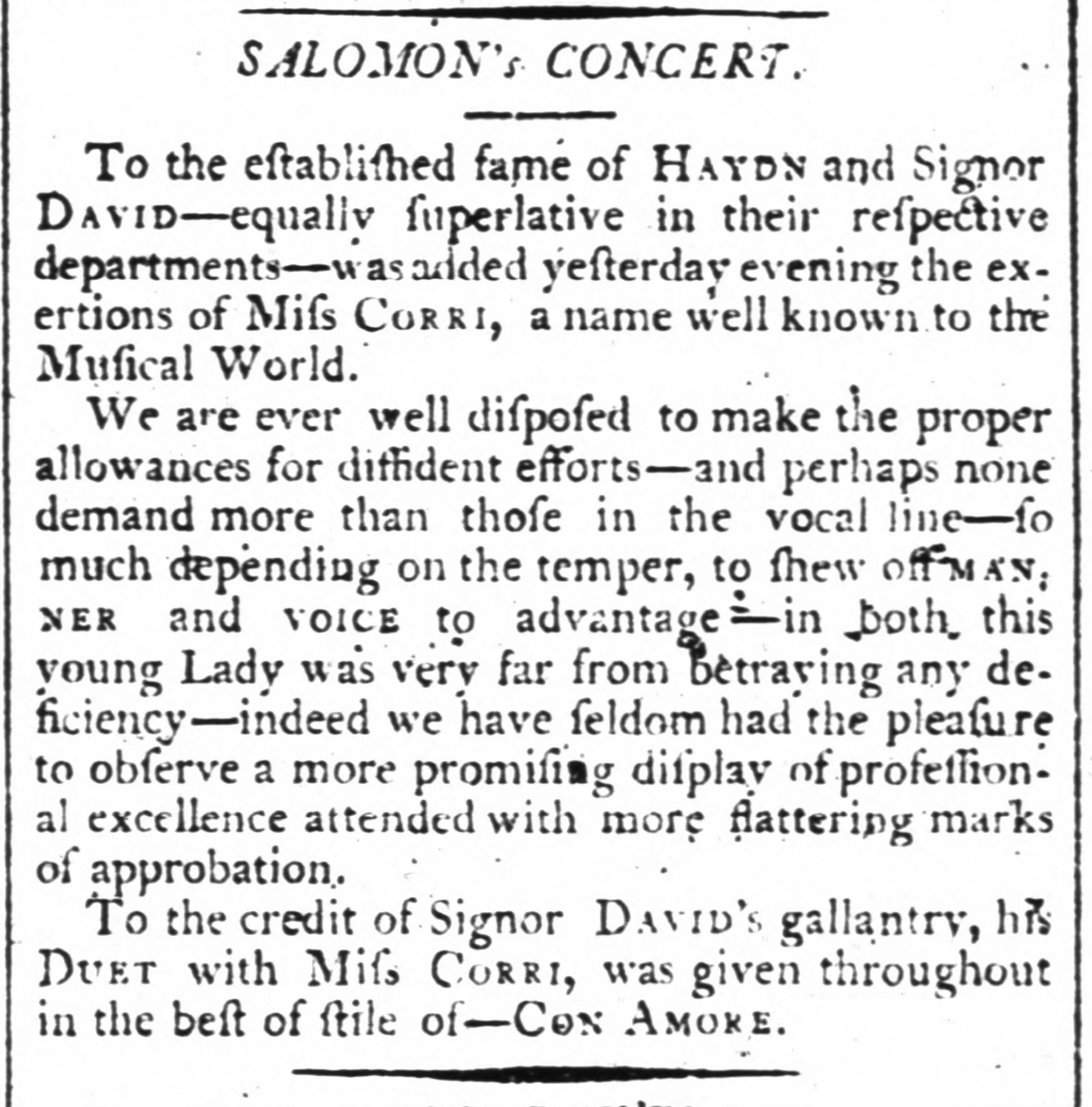
Domenico Corri moved his family to London in 1788, primarily in search of better opportunities for his daughter’s future, and the Corris were quickly entrenched in London’s elite music circles (Hill, 209; Jones et al.). Most of Sophia Corri’s early performances in London seem to have been vocal performances. She frequently performed “at the music rooms in London,” almost immediately upon the family’s arrival in London (Highfill et al., 527). Her reputation as a musician is confirmed in a press review of her performance in the Salomon concert series on April 15, 1791. The critic for The Times reported that her name was already “well known to the musical world” while praising her “professional excellence,” and noting that her performance was very well received
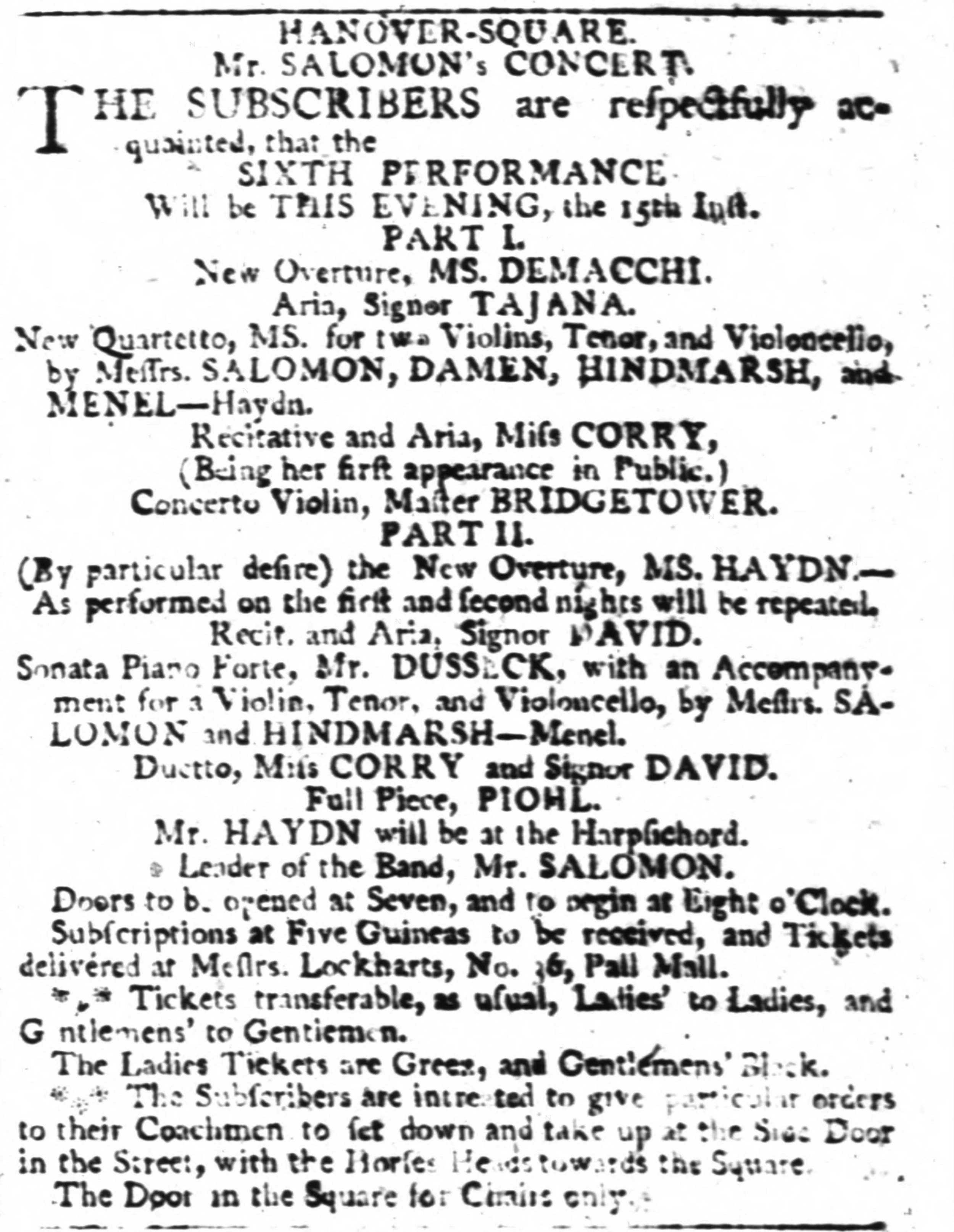
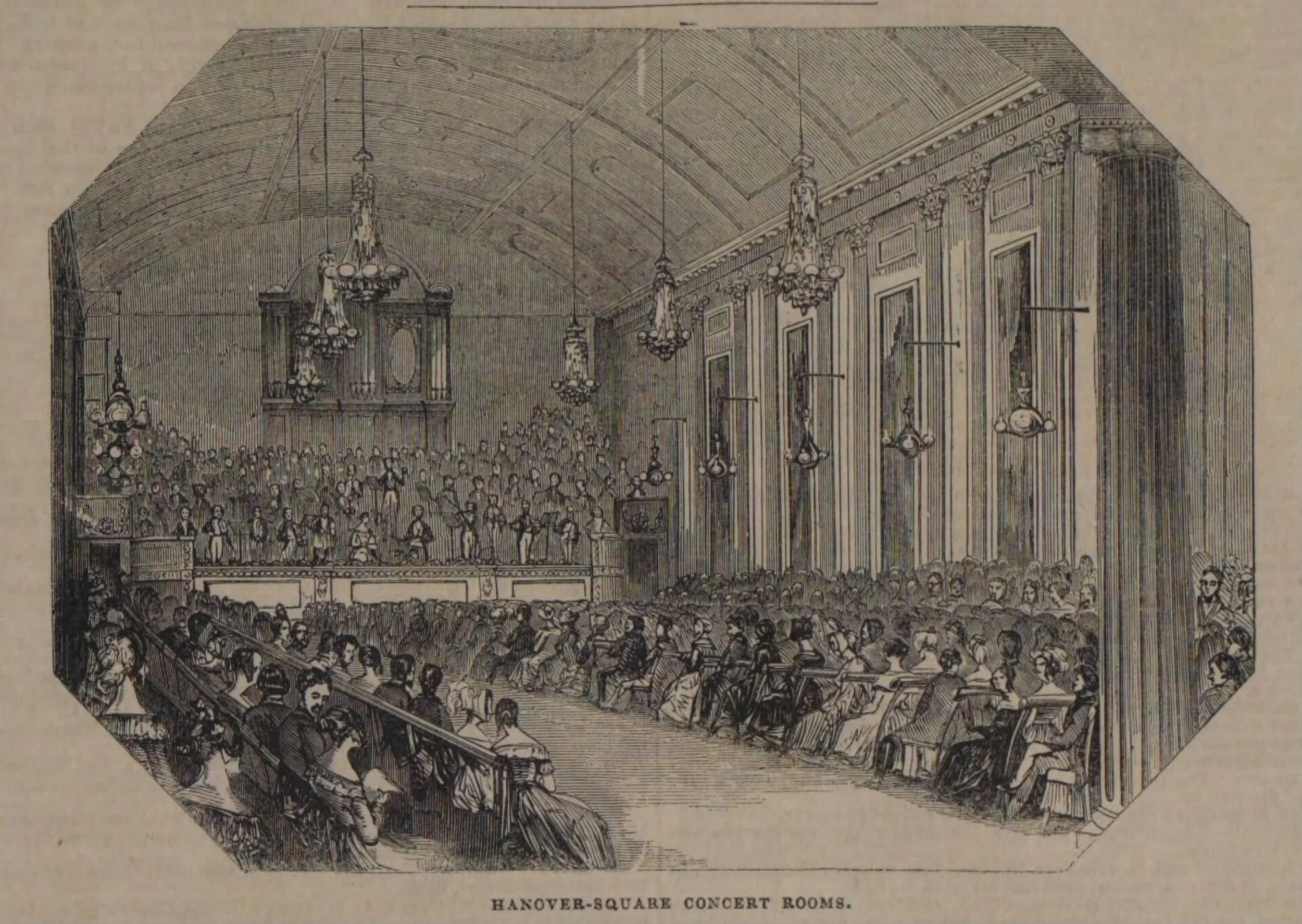
This prestigious concert series featured a regular cast of musical luminaries, with Johann Peter Salomon himself on first violin and “Mr. Haydn” at the harpsichord.
For the lucky few like Corri who had support and made it to their teens as performing musicians, there was still one last hurdle to be cleared: marriage. The public spectacle of a woman on the stage amounted to a display of the body in exchange for money, an association with immorality that would threaten a husband’s social standing every bit as much as his wife’s. What’s more, a married woman could not perform in public without her husband’s written consent, and her earnings afterward legally belonged to him (Hill, 72). And so, in deference to husband, public opinion, or both, women who had been performers in their childhood and teen years often retired from the stage once they married. Women who married other musicians, though, were much more likely to continue performing after marriage (Hill, 74).
Sophia Corri had built a thriving career as a highly respected vocalist by the time she married Jan Ladislav Dussek (1760-1812) in August of 1792. Dussek was a famous Bohemian virtuoso pianist and composer who spent the 1780s traveling and performing in Europe's royal courts. He played for Catherine the Great and was a particular favorite of Marie Antoinette (Craw). He arrived in London in 1789, likely fleeing the outbreak of Revolution in France, especially given that his connections there were to the aristocracy (Craw). Dussek was retained to play pianoforte in the 1791 Salomon concert series, and if they had not been acquainted with each other through mutual involvement in the same musical circles, this is certainly how he and Sophia met. They performed together often in 1791, Dussek joining forces with the Corri family for concerts in Scotland and England.
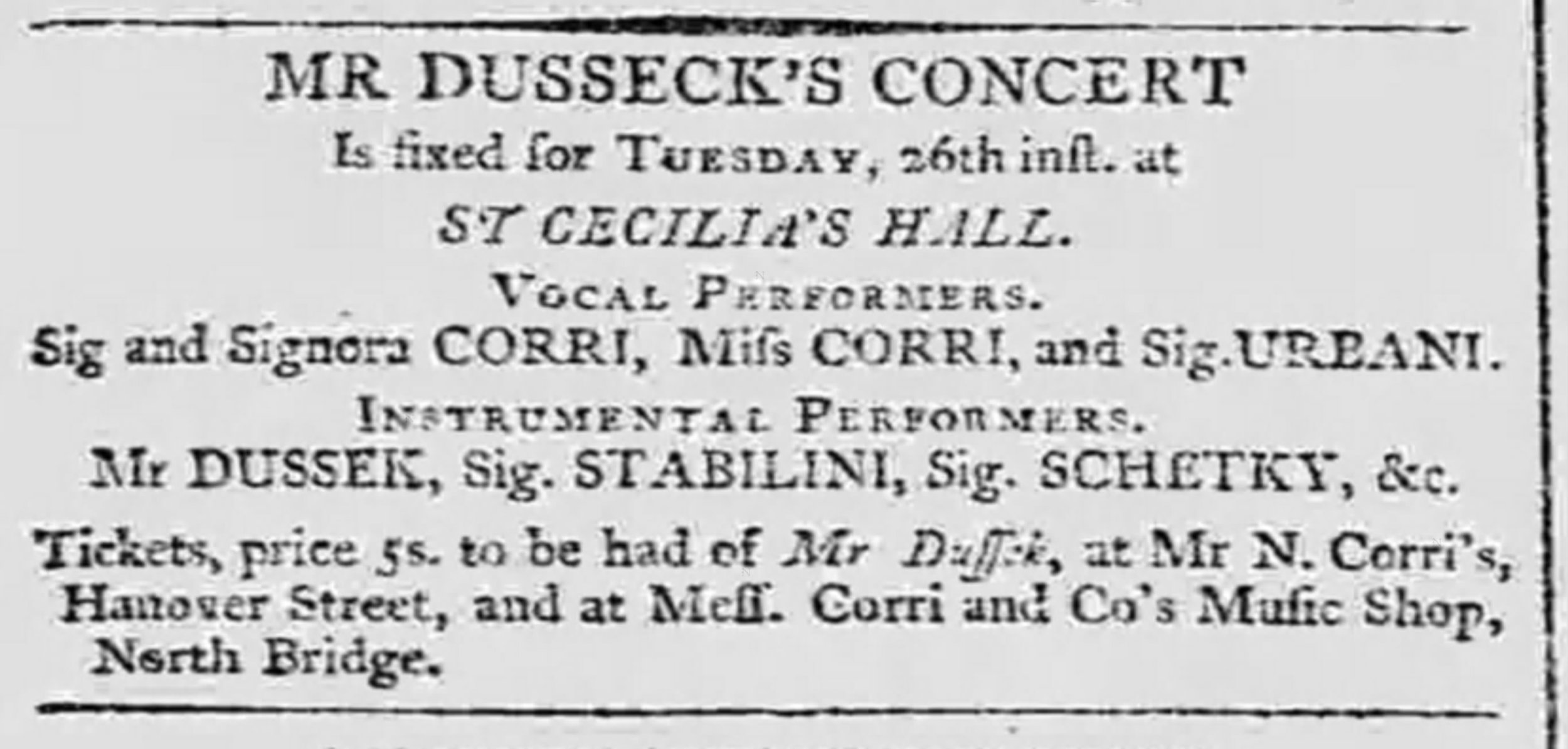
After they were married, the Dusseks toured all over the British Isles, to rave reviews (Sainsbury, 224). For the first decade of her marriage, Sophia Dussek* focused on collaborative piano, voice, and harp performance, only performing a solo keyboard concerto once in March of 1793 (Clark, 154).
Concertizing in the eighteenth century was as unreliable a means of income as it is today, and performers invariably relied on diverse musical enterprises like composing, publishing, selling instruments, and teaching to augment their incomes (McVeigh, 11). The Corri-Dussek family, now united through marriage, was “highly active” in London’s music community in many such roles (Clark, 154). Sophia Dussek participated in all of the family’s business endeavors, and in fact, this was not at all an unusual position for a woman at the time (Davidoff and Hal, xxv). The family partnered with the Broadwood piano company, who provided them with pianos and instrument maintenance, while the Corri-Dusseks served as sales agents for Broadwood’s pianos (Clark 154). Dussek, her father, and her husband all composed and published their own music, and the latter two ventured into music publishing together.
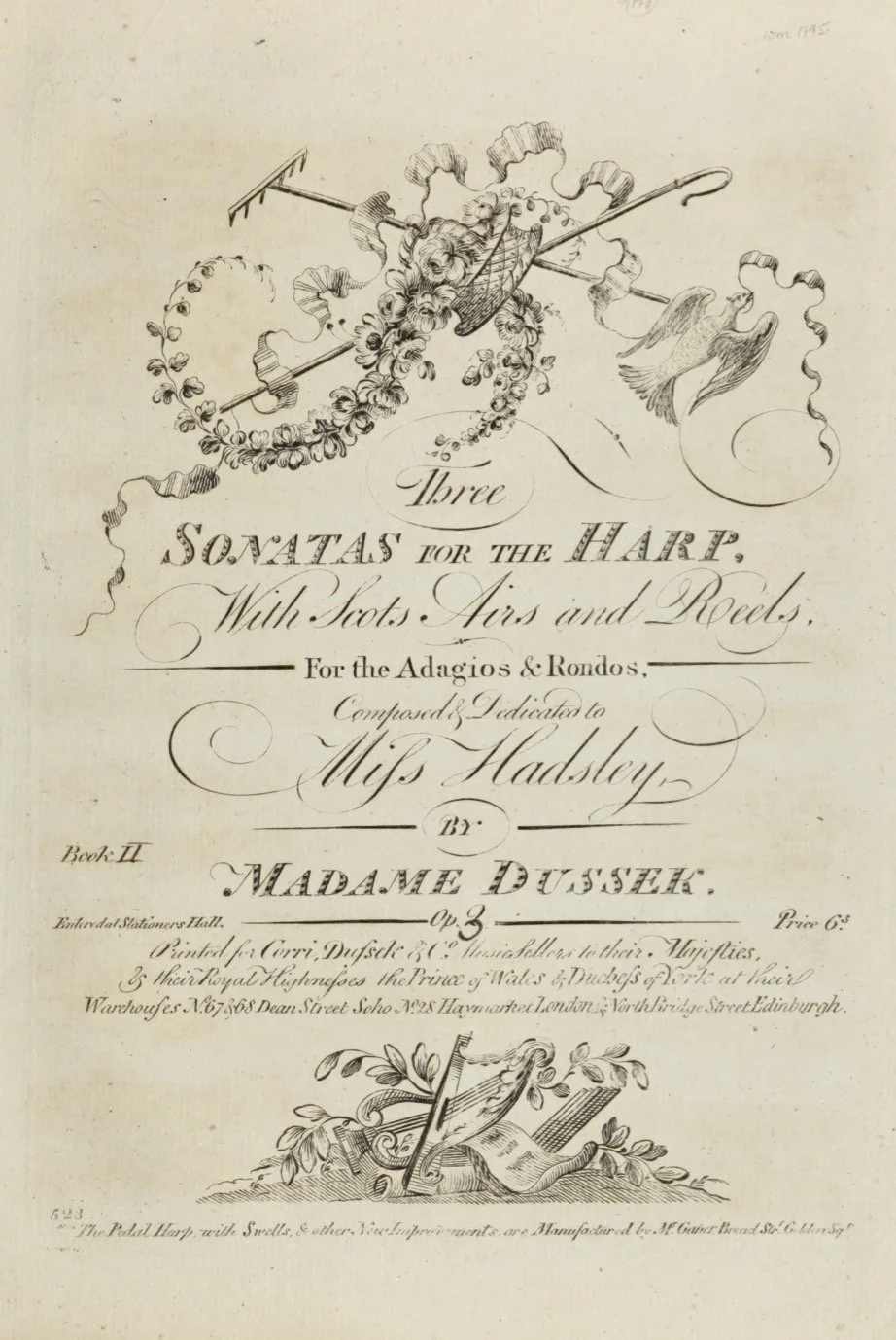
Much of Sophia Dussek’s published music is aimed at domestic musicians–the middle- and upper-class women that drove the burgeoning market for sheet music. These include arrangements and sets of variations based on popular tunes and folk songs, rondos, and accompanied sonatas. However,it is her harp music for which Sophia Dussek is most remembered. Her three sonatas for harp, Opus 2, have long been beloved staples of the harp repertoire.
They had been misattributed to her husband for nearly two centuries, the only known score a French edition that credited only “Dussek” as the composer (Weidensaul, 3). In 1979, Howard Allen Craw discovered a copy of the Corri, Dussek, & Co edition that confirmed Sophia had actually authored these works (Weidensaul, 3).
Another of the Corri-Dussek family’s publishing ventures was a subscription-based music journal, published in collaboration with Ignaz Pleyel, a pianist, composer, and piano-builder, who was in London while displaced by the French Revolution. Beginning in January of 1797, each issue of the aptly titled Pleyel, Corri, and Dusseks’, Musical Journal promised one work each for solo piano, solo harp, and voice with keyboard or harp accompaniment. The professional-level repertoire was curated by the editors for a clientele who had a high level of musical skill and the financial means to access the harp or the piano, two rather expensive instruments (Clark, 161).
At just 21 years old, Dussek served as one of the journal’s editors, a sign of the “strong professional position that women occupied as working musicians” in London at this time (Clark, 152). The journal featured works by popular composers like Mozart as well as their own works, and three of Dussek’s works were included in the journal’s short run (Clark, 150, 165).
As an editor, Dussek shared in the responsibility for the selection of the published music, but also the imagery that was presented in the journal. The frontispiece featured an image of Mount Parnassus, the home of poetry, music, and literature in ancient Greek mythology. The image of Parnassus had been conjured by the composers and music writers for centuries as a signifier of artistic achievement and cultural exchange, and serves as a fitting metaphor for the musical world of late eighteenth century London and functions as a public demonstration of the Corri-Dussek family’s position at its center (Clark, 152). Unfortunately, the journal was also short-lived. The editors intended to release each monthly issue in three installments. The first issue appeared on January 1, 1797, but only seven issues are known to have been produced (Clark, 150). Jan Dussek was not a savvy businessman, and his business ventures with the Corri family, including the publishing company, failed and left the family in financial ruin. He fled England in 1799 to escape his creditors and left Sophia, pregnant with their first child, behind. He also abandoned Domenico Corri, who was jailed for bankruptcy (Craw).
On September 20, 1800, Dussek gave birth to the couple’s daughter Olivia, who grew into a multi-instrumentalist and composer in her own right. There is no evidence that Jan Dussek ever saw his daughter, though a letter to his wife, dated April 22, 1806, and printed in a 1975 biographical dictionary suggests they were corresponding, and that he had hopes of being briefly reunited (Highfill et al., 526). It is not clear whether the letter was ever sent. Whether they had a secret rendezvous or not, two more children were born to Sophia Dussek—a daughter in 1803 and a son in 1804. Her husband is listed as their father in church baptism records (Hill, 213).

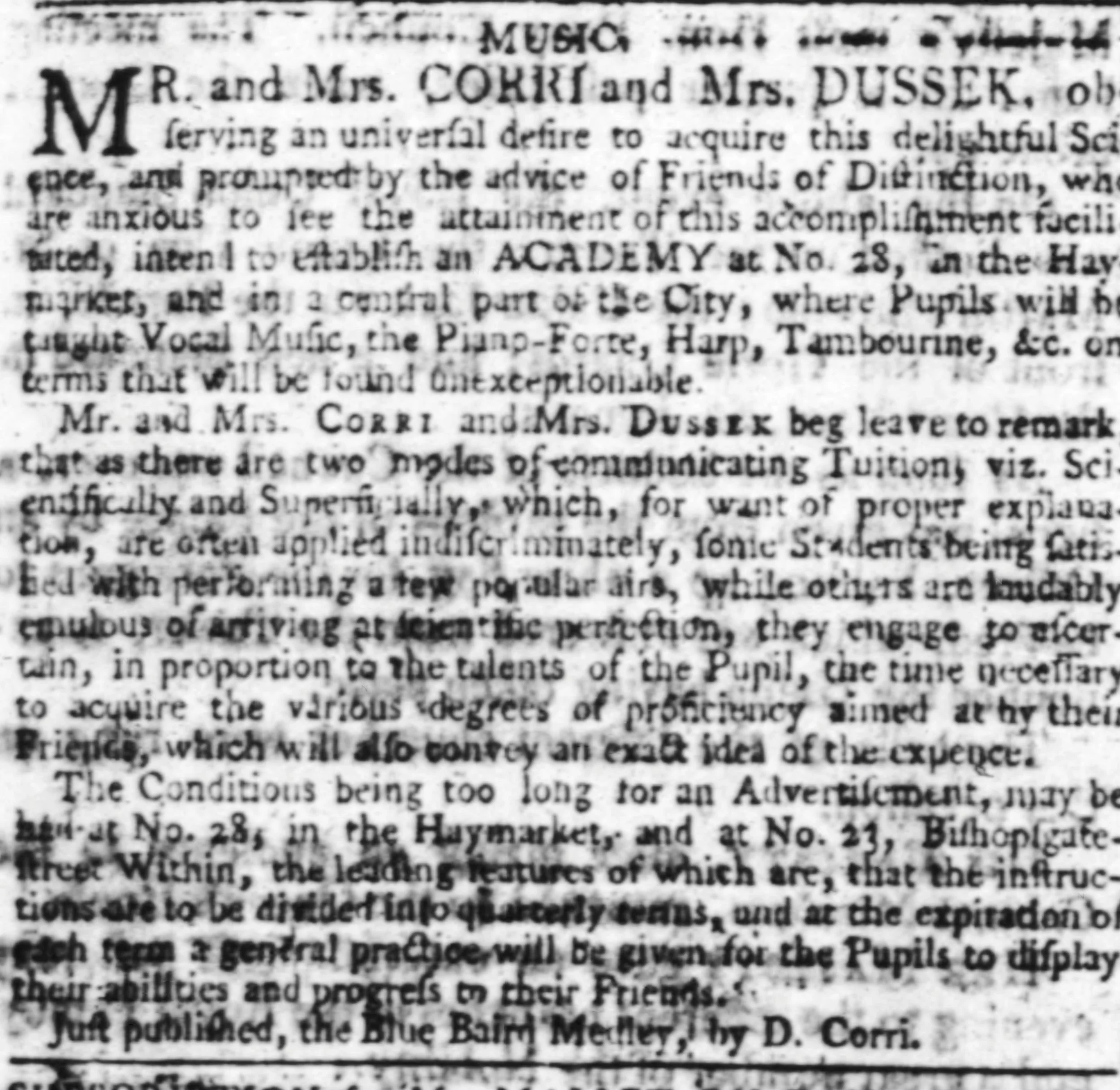
With her husband out of the country indefinitely, Sophia Dussek returned to concertizing as a solo pianist and would do so until she retired from the stage in 1807 (Salwey, 287; Hill, 214). By January of 1801, she established a music academy with her parents in Paddington, a village situated between London and Manchester that was on the verge of a construction boom (Walford). They advertised their teaching services as a response to the “universal desire to acquire [the] delightful Science” of music.
Jan Ladislav Dussek died in France in 1812, having never returned to England. Four months after his death, Dussek married violist John Alois Moralt. She continued her public career as Sophia Dussek-Moralt and published her music as “Madame Dussek” until her retirement in 1817 (Hill, 216).
At the end of the seventeenth century, public and private spheres were not the clearly separate spaces that we often imagine them to be. Rather, they were components of a “powerful discourse” that would have long term consequences for how we think of eighteenth century women’s lives (Davidoff and Hall, xviii). Lived experience is always more complicated than public discourse would have us believe. Women, in all times and places, have been musicians, composers, teachers, and publishers. They certainly faced obstacles along the way, but just as certainly, the particular circumstances of their lives created possibilities.
For Sophia Dussek, Georgian London’s unique sociocultural environment, her gender and class status, and the advantages of a musical family and a musical marriage created opportunities for her that were not available to all women, but her career was hardly singular. Nicholas Salwey’s survey of late eighteenth century performance records makes this clear, listing Maria Parke, Jane Mary Guest, Maria Hester Reynolds and Cecilia Barthélemon, Veronika Cianchettini (Dussek’s sister-in-law), and Anne-Marie Krumpholz among her female contemporaries (Salwey, 273).
Dussek’s comprehensive music education provided her the means to adapt to changing social and personal circumstances, forging a long and successful career in music as she progressed from child prodigy to teen singing star to highly respected music professional. She shaped public taste through her performance repertoire selection and through her position as editor of a music journal. Her creative flexibility and keen understanding of her audience are evident in her published compositions that cater to both skilled musicians and consumers of popular sheet music. When faced with raising her children on her own, she moved to the suburbs and opened a music studio, still maintaining an active performing schedule. Her career was remarkable, but so were those of many of her female contemporaries who also carved out their own paths because of, and in response to, the particular circumstances of their everyday lives, just as we do today.
*From here forward, to avoid confusion, “Dussek” will refer to Sophia Dussek and “Jan Dussek” to her husband.
Bibliography
Clark, Katelyn. “The Early Pianoforte School in London’s Musical World, 1785-1800: Technology, Market, Gender, and Style.” PhD diss., University of Toronto, 2019. ProQuest (13809928).
Craw, Howard Allen, Matjaž Barbo, Barbara Garvey Jackson, and Bonnie Shaljean. "Dussek family." In Grove Music Online, edited by Deane Root. Oxford University Press, 2013. http://www.oxfordmusiconline.com.
Davidoff, Leonore, and Catherine Hall. Family Fortunes: Men and Women of the English Middle Class 1780–1850. Routledge, 1987.
Dussek, Sophia. “A Rondo for the Harp.” In Pleyel, Corri, & Dussek’s Music Journal No. 3 (1797): 9-12. Corri, Dussek, & Co., 1797. https://hdl.handle.net/2027/mdp.39015080961462
Dussek, Sophia. “Three Sonatas for the Harp, with Scots Airs and Reels for the Adagios & Rondos, Book II.” Corri, Dussek & Co., n.d.
“Hanover-Square.” The Times, April 15, 1791.
“Hanover-Square Concert Rooms.” The Illustrated London News, June 24, 1843.
Highfill, Jr., Philip H., Kalman A. Burnim, and Edward A. Langhans. A biographical dictionary of actors, actresses, musicians, dancers, managers & other stage personnel in London, 1660-1800, Volume 4: Corye to Dynion. Southern Illinois University Press, 1975.
Hill, Michelle Tanya. “The Accompanied Keyboard Sonata: Contributions to the Genre by Women Composers in England ca. 1776-1810.” PhD diss., University of California Los Angeles, 2001. ProQuest (3024095).
Jones, Peter Ward, Rachel E. Cowgill, J. Bunker Clark, and Nathan Buckner. "Corri family." In Grove Music Online, edited by Deane Root. Oxford University Press, 2013. http://www.oxfordmusiconline.com.
Leppert, Richard. The Sight of Sound: Music, Representation, and the History of the Body. University of California Press, 1995.
McVeigh, Simon. “Introduction.” In Concert Life in Eighteenth-Century Britain, edited by Susan Wollenberg and Simon McVeigh. Routledge, 2016.
Morgan, Elizabeth. “The Accompanied Sonata and the Domestic Novel in Britain at the Turn of the Nineteenth Century.” 19th Century Music 36, no. 2 (2012): 88-100. https://doi.org/10.1525/ncm.2012.36.2.088.
Morgan, Elizabeth Natalie. “The Virtuous Virtuosa: Women at the Pianoforte in England, 1780-1820.” PhD diss., University of California Los Angeles, 2009. ProQuest (3364115).
“Mr. Dussek’s Concert.” The Caledonian Mercury, July 23, 1971.
“Music,” The Times, January 2, 1801.
Sainsbury, John S. A biographical dictionary of musicians, from the earliest ages to the present time. Comprising the most important biographical contents of the works of Gerber, Choron, and Fayolle, Count Orloff, Dr. Burney, Sir John Hawkins, &c. &c. together with upwards of a hundred original memoirs of the most eminent living musicians; and a Summary of the history of music. Volume I, 2nd Edition. Sainsbury & Co., 1827.
“Salomon’s Concert.” The Times, April 16, 1791.
Salwey, Nicholas. “Women Pianists in Late Eighteenth-Century London.” In Concert Life in Eighteenth-Century Britain, edited by Susan Wollenberg and Simon McVeigh. Taylor and Francis, 2016.
Schmitz, Oscar A.H.. Das Land ohne Musik : englische Gesellschaftsprobleme, 4th edition. G. Müller, 1914. https://archive.org/details/daslandohnemusik00schmuoft
Vickery, Amanda. The Gentleman’s Daughter: Women’s Lives in Georgian England. Yale University Press, 2003.
Walford, Edward. “Paddington.” In Old and New London: Volume 5. Cassell, Petter & Galpin, 1878. British History Online. Accessed March 9, 2026. https://www.british-history.ac.uk/old-new-london/vol5/pp204-224.
Weidensaul, Jane B. “Notes on Jan Ladislav Dussek and Mrs. Dussek (Sophia Corri): A Review of Contemporary Sources.” American Harp Journal 14, no. 2 (Winter 1993): 3-5. http://online.fliphtml5.com/ncmxc/nmyf/.
Portrait of Sophia Dussek
Danloux, Henri-Pierre. “Portrait of Sophia Dussek (1775-1831).” Ca. late eighteenth century.
Links to Performances
1) Sonata no. 3, Op. 2: https://youtu.be/0Wz7mqFnFBc?si=66i5JDuhD3GmO0Ce
2) Violin Sonata in D: https://youtu.be/quAQ5qq5_Qc?si=PzDUKm87xCF7Pkt4
3) Allegro from Sonata in D minor: https://youtu.be/SuzwQuo18pE?si=zdwqHo8xShdqLec4
4) Sonata in A major, Allegro: https://youtu.be/ZRDD-euZEHk?si=nDuG87tdsL93J7Kz
5) Sonata in A major, Allegretto: https://youtu.be/KCdFsPTb7Ro?si=C1loFbnx-83D_Hc8
About the Author:
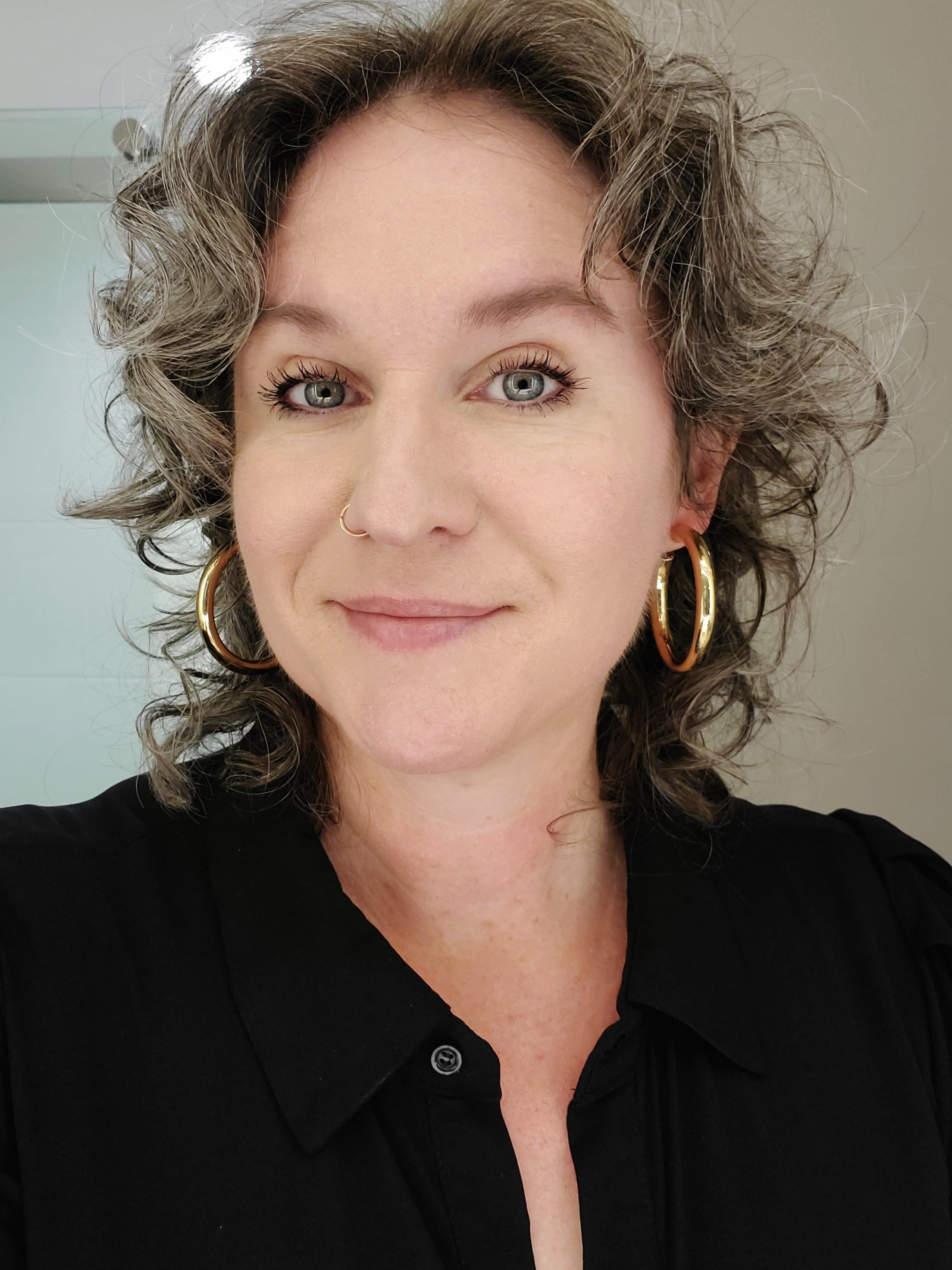
Christy Sallee is a pianist, music educator, and musicologist from Lakeland, FL. She is a PhD candidate in musicology at the University of Florida. She received her master’s degree in Piano Performance from the University of South Florida and has taught class piano and applied piano for 15 years. Christy’s performance interests and her work as an educator are both organically connected to her musicological research, with an emphasis on historically underrepresented composers and the exploration of nontraditional repertoire. Her doctoral research is centered on a series of piano works by fin-de-siècle composer Mélanie Bonis known as Femmes de légende.