
Elfrida Andrée: A Pioneering Swedish Composer
A Young Composer is Born
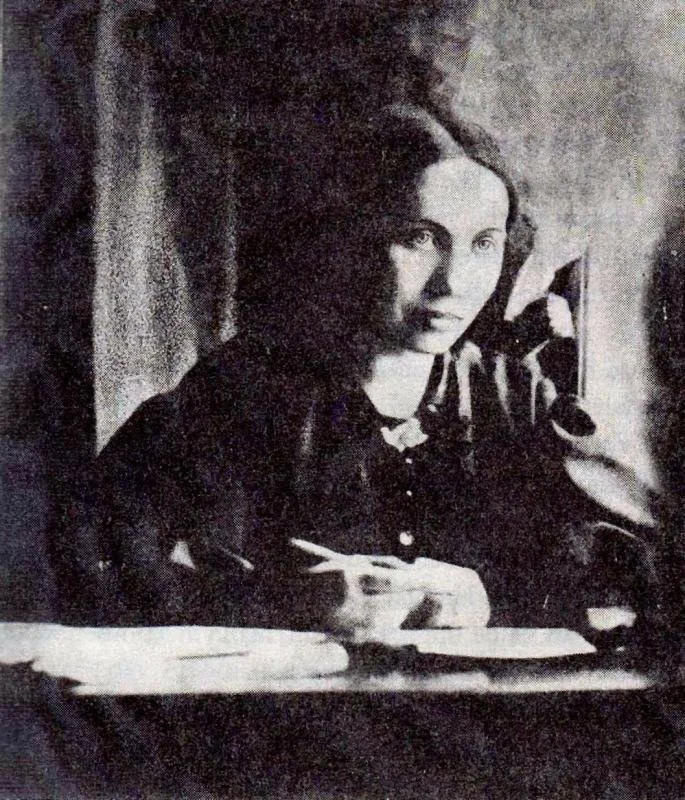
Elfrida Andrée, c. 1900, anonymous
Elfrida Andrée was born to Andreas and Lovisa (Lyth) Andrée on February 19, 1841 in Visby, Sweden, located on the small island of Gotland. Her father was a physician and earned enough to pay for an education in music for Andrée, her older sister Fredrika (1836-1880), and her younger brother Tor (1848-1901). A progressive thinker, Andreas Andrée was interested in things such as electric lighting and physical fitness. This liberal outlook proved to greatly benefit his two daughters in particular who otherwise would not have had equal opportunity for a well-rounded education. Andreas, an amateur musician himself, taught his children at home or involved local music teachers, thus Andrée learned voice, harp, and organ. Even at the young age of seven, Andrée had a passion for composition and began to compose small works. By the time she was fourteen, she had composed at least nineteen pieces for piano, voice, and choir.
In 1855, at the age of fourteen, Andreas sent Andrée to study music at the finest music institution in Sweden, the Royal Academy of Music (Kungliga Musikaliska Akademien) in Stockholm. While at the Academy, she studied voice, harp, and organ performance. Partway through her schooling, Andrée had to choose between pursuing voice and following in the footsteps of her sister Fredrika, an opera singer, or pursue the study of the organ. She ultimately chose to specialize in organ performance, but since she was a woman, the Academy regarded her as an external student in this discipline because, at the time, only male students were eligible to receive this degree. Despite this restriction, Andrée was allowed to study with the conservatory’s organ professor, Gustaf Mankell (1812-1880), whilst she attended the university. In 1857, at the young age of sixteen, Andrée passed the Royal Academy’s organists’ examination as both the youngest student and the first woman to do so, a triumph for the young musician.
Elfrida Achieves Ambitious Firsts for Women
Although Andrée quickly sought work as an organist at the Church of St. Jacques in Stockholm, she was refused appointment in 1859 on advice of the King’s archbishop who touted their interpretation of the biblical scripture, 1 Corinthians 14:34 “Women should remain silent in the churches” (1 Cor 14:34 NIV). There was also a belief in the church that a woman organist was “distracting, indecent, and disturbing to the atmosphere of meditation” (Ford 1997, 60). This setback did not deter Andrée and her father. For the next four years, they endlessly appealed the government’s restrictions on women in church. In 1861, they received a partial victory. Parliament passed an amendment declaring that an unmarried woman over the age of twenty-five could now legally be a professional organist. Andrée, though only twenty at the time, somehow managed to receive brief appointments at the Finnish and French Reform churches in Stockholm in addition to opportunities at the Royal Teaching Academy and the Allins School for Girls. During these years, Andrée and her father also fought for the reversal of the law banning women from being telegraph operators, and with the success of this annulment, Andrée became the first woman in Sweden to be certified as a telegraphist. It is theorized Andrée’s “father wanted to make sure she could ‘earn her own way’ in life if her music career faltered,” but she never had to rely on this profession as her music career was on the brink of success (Pickett 2008, 13).
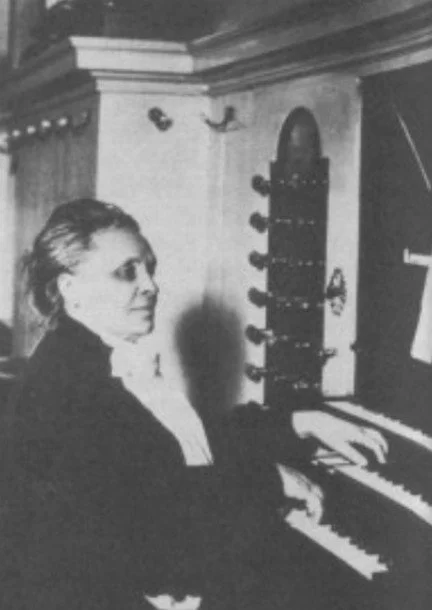
Elfrida Andrée at the organ in Gothenburg Cathedral
From 1859-1861, Andrée studied composition at the Royal Academy of Music under the tutelage of Ludvig Norman (1831-1885), a famous Swedish composer, conductor, pianist, and teacher. Born in Stockholm, Norman studied music at the Leipzig Conservatory under Niels Gade (1817-1890), another composer with whom Andrée would cross paths. Andrée composed another dozen works during her student years (beginning in 1855), including some of her first orchestral works, possibly due in part to Norman’s focus on chamber and orchestral composition. Following the completion of her degree on 6 November 1861, earning marks of the highest level in all aspects of composition (except orchestration where she received the second highest level), Andrée spent the next six years in Stockholm. In 1867, at the age of twenty-six, Andrée applied for one of the most prestigious posts as the organist for the Gothenburg Cathedral (Göteborgs domkyrka) in Gothenburg (Göteborg). Out of the eight finalists, Andrée was the sole woman, yet she was unanimously appointed the position and subsequently became the first female cathedral organist in Sweden, which was quite a remarkable feat. In a letter to her brother, Tor, Andrée wrote, “Glory be ambition! I am tempted to compare my own possibilities to an elastic band. Sometimes I feel that I possess half an aune [measurement], I stretch it, and I get a whole aune, or perhaps one and a half aunes. Even ambition gets greater with one’s own ability” (Ford 1997, 60).
On 19 May 1867, Andrée began her position at the Gothenburg Cathedral where she worked as an organist and music director for the remainder of her career. Among her many duties, she put on over 800 concerts for working-class citizens. She also taught the organ whilst in this position, and by 1891, Andrée’s former female students held all but two of the organist posts in Göteborg. Though she never married, whether due to ideals introduced by feminist John Stuart Mill in his essay Subjection of Women or because of enforced regulations from the church, Andrée was not without romance, as she turned down at least two suitors in her youth. Instead, she focused her time on proving herself not only as a musician but also as a composer, and took on the task of writing music for orchestras rather than just smaller works for piano and voice (the choice of many of her female contemporaries).
A Disastrous Performance
The Stockholm Philharmonic Orchestra premiered her first symphony in 1869, Symphony No. 1 in C Major, at Hammar’s Theater in Stockholm. Despite hiring professional copyists in Stockholm to create orchestral parts, the scores were riddled with mistakes causing chaotic rehearsals and a disastrous performance. Andrée remarked in a letter to her mentor Ludvig Norman, “The performance was terrible, and I think the musicians deliberately played wrong notes. Fredrika and I left when the Finale started, and the first violins were continually behind the rest of the orchestra one entire measure.” (Ford 1997, 60). The reviewers misunderstood the performance and thus believed “The Symphony may be the most difficult ever written and should not be played again” (Ford 1997, 60). Andrée was ill for several days after this egregious performance. Following this fiasco, her father became less supportive of her large-genre compositional career and recommended she turn to writing salon music. Andrée, furious at this suggestion, wrote to her father, “The popularity of all these little ladies with their piano fantasies or pretty songs is not what I want to do…I prefer to be overcome, mentally and physically, because of a work where I gave my best than to be praised for something hurriedly put together. Above all, I want to remain faithful to myself and deserving of my own self-esteem” (Pickett 2008, 15).
The Elevation of Womankind
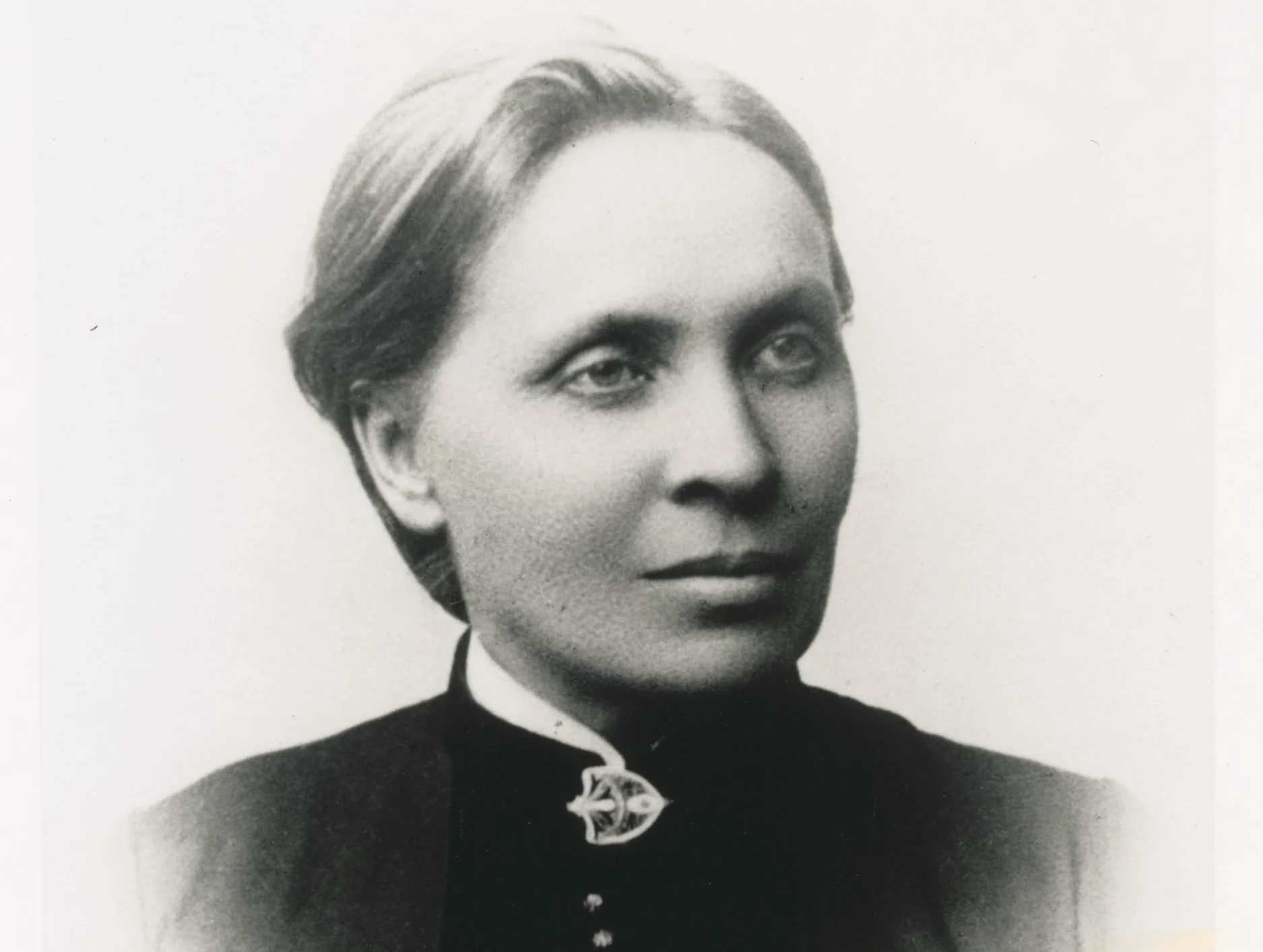
Andrée, date unknown, anonymous
Andrée did not let this incident affect her compositional output or performance career. Her motto was “the elevation of womankind” (det kvinnliga släktets höjande), coined in the 1870s after reading Mill’s The Subjection of Women, and it seems she was determined to positively alter life for future women composers. She remarked, “How many times haven’t I been bitter when someone says that women cannot be mentioned in the context of serious art music?” This bitterness appears to have motivated Andrée as she composed approximately 100 works between 1859-1912, including two symphonies, two Swedish masses, numerous chamber and choral works, a concert suite, a concert overture, and a three-act opera produced in collaboration with Selma Lagerlöf, a Pulitzer Prize winning author (Pickett 2008, 19). The opera, Fritiofs Saga, was entered into a competition to be premiered at the Royal Theatre in Stockholm, but it did not win which prompted Andrée to rework the opera into a five-movement suite for orchestra, Fritiof Suite, which has since been recorded. The full opera was performed for the first time in concert form in November 2019 by Göteborg Opera in Sweden. Andrée’s preference was always for the orchestra and she expressed, “If you could conceive of the ideal light in which the orchestra appears to my sight! It is an interpreter of the wondrous surgings of the soul” (Axtell 2004, ix).
To further herself in composition, Andrée studied in Copenhagen with Niels Gade during the summer of 1870. Gade, an organist and composer, spent several years in Leipzig as Felix Mendelssohn’s assistant (this is perhaps why Andrée was greatly inspired by the works of Mendelssohn). Not known for being a proponent of women composers, Gade agreed, reason unknown, to tutor Andrée even though he had a published declaration stating, “a woman cannot accomplish anything in the way of composing” (Pickett 2008, 15). He was appalled after learning of Andrée’s profession as a church organist, but evidence of her abilities must have greatly impressed Gade because he personally invited Andrée to give an organ recital at St. Holmens Church where he served as the primary organist. Gade continued to advocate for Andrée, encouraging her to give recitals in other countries and endorsing her concerts in Leipzig and Dresden where she presented several chamber works at the Leipzig Conservatory. While in the area, Andrée offered to give a recital at the Thomaskirche, the church where Bach (1685-1720) had worked and performed, but was informed by the clergy that “a woman in the organ loft…would be highly inappropriate and contrary to all of our customs and ideas” (Ford 1997, 61).
“My Brain is Big Enough to Handle an Orchestra!”
One of Andrée’s most well-known works is Snöfrid, a cantata written in April 1879 based on a text by Viktor Rydberg, a prominent Swedish writer. The piece, composed for soloists, choir, and orchestra, premiered on April 26, 1879 in Gothenburg. In a letter to Fredrika, Andrée wrote about her frustration prior to the performance as the concertmaster and choirmaster tried to persuade the musicians and vocalists to abandon scheduled rehearsals, but the choir refused to entertain this idea. Ultimately, the premiere was given to a full house and subsequently every major ensemble in Sweden performed Snöfrid. That same year, Andrée completed her Symphony No. 2 in A minor which she began under the tutelage of Gade. She also received the honor of being elected to the Swedish Academy of Music. Her joy was short-lived, as soon after this achievement her sister Fredrika passed away from tuberculosis. Fredrika’s daughter, Elsa Stenhammar, was only thirteen years old at the time, and Andrée entered into Elsa’s life as a maternal figure, nurturing her musical talent. Elsa was an accomplished pianist and vocalist and later became both Andrée’s caregiver and the executor of her estate, which is why Andrée’s personal papers and manuscripts are so carefully preserved at the Musik- och teaterbiblioteket in Stockholm.
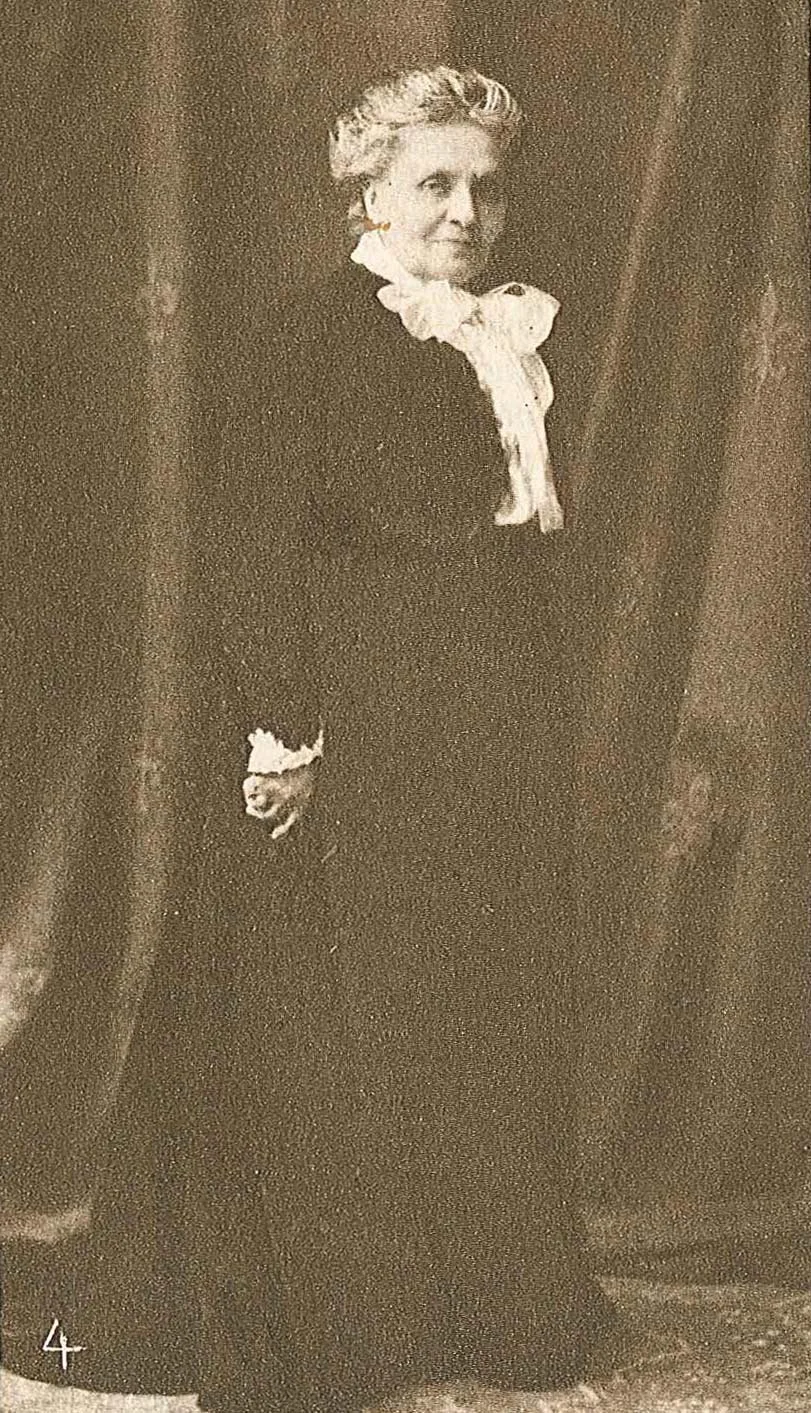
Andrée, 1916, anonymous
Following the death of her sister, Andrée traveled to Paris and London where she gave concerts at Albert Hall, Alexandra Palace, and the Crystal Palace by way of a connection with the “Swedish Nightingale” Jenny Lind (1820-1887), a renowned opera singer, and her husband Otto Goldschmidt, a composer and orchestra conductor. Andrée and Lind had opposing views of women in music as Lind believed “it is impossible for a woman’s brain to understand an orchestra…there must be a limit to what a woman can and cannot do” (Ford 1997, 61).
In a letter to S.A. Hedlund (1821-1900), a close family friend, Andrée wrote, “my blood started to boil, and before I knew what I was doing, I…started to speak about the right to be able to work with what one wants and loves to do, and I finished by saying that I for my part could show any time that my brain is big enough to handle an orchestra!” (Ford 1997, 61). She later played excerpts of her symphony on the piano and Lind was quite astonished to learn from her husband that Andrée had correctly orchestrated all of the instruments.
Andrée had several additional accomplishments in her life. On April 5, 1893, her Symphony No. 2 was finally premiered in Gothenburg, fourteen years after its completion. Although it received a standing ovation, Andrée was not permitted to acknowledge the generous audience reception from the stage because she was a woman. The audience even demanded for an encore of the last movement and the conductor refused to oblige. Not to be discouraged, Andrée entered the piece in an international competition in Brussels where it won second prize. In 1897, Andrée became the director and conductor of the Working Man’s Institute of Folk Concerts (Folkkonserterna) in Gothenburg where she organized approximately 800 concerts over the next 28 years. With mixed programs and inexpensive tickets, these concerts eventually built up a new audience to attend large orchestral performances. Andrée premiered many of her works at these concerts, often conducting the pieces herself. In 1911, Andrée was a keynote speaker at the International Suffragette Conference in Stockholm where she premiered a piece written specifically for the event. In her speech, she remarked that she wished to “give freedom to the bound, sight to the blind, hearing to the dumb…and courage to the frightened” (Ford 1997, 62).
A Life Dedicated to Future Female Composers
Elfrida Andrée faced many obstacles throughout her life and after a long and successful career, she was finally laid to rest in Gothenburg on January 11, 1929, just five weeks shy of her eighty-eighth birthday. She is buried at Skogskyrkogården in Stockholm, next to her parents and siblings, where her gravestone is decorated with a small engraving of organ pipes. Andrée made great strides for women in Sweden as the first Swedish woman organist, the first Swedish woman to conduct an orchestra, and the first Swedish woman to compose large-scale orchestral music. Furthermore, the advances Andrée made for women composers in Sweden, and worldwide, should not be taken lightly in the field of music. Andrée remarked that her life’s purpose was served knowing that “other women to whom the same vocation has been given will be able to continue their path without obstacles, humiliation, or difficulties.” (Ford 1997, 63). Her humility is apparent and her compositional talent even more remarkable, reminding us to impart upon Andrée the true recognition she deserves.
BIBLIOGRAPHY
Andrée, Elfrida. Svensk mässa No.1. Gothenburg Symphony Orchestra and Cathedral Choir.
Conducted by Ann-Marie Rydberg. Elfrida Andrée: Svensk mässa Nr.1 (1902). Intim Musik IMCD098, 2004. Naxos Music Library.
Andrée, Elfrida. Two Chamber Works: Piano Trio in C Minor and Piano Quartet in A Minor. Edited
by Katherine L. Axtell. Middleton, WI: A-R Editions, Inc. 2004.
Ford, Karrin. "The Life and times of Elfrida Andrée." The American Organist 31, no. 9 (1997): 60-63.
Öhrström, Eva. "Elfrida Andrée." Trans. Roger Tanner. Swedish Musical Heritage. 2014.
http://www.swedishmusicalheritage.com/composers/andree-elfrida/.
Öhrström, Eva. Elfrida Andrée, Ett levnadsöde. Stockholm: Bokförlaget Prisma, 1999.
Pickett, Susan. “The Elevation of Womankind.” The Maud Powell Signature: Women in Music 2, No.3
(Autumn, 2008): 11-22
http://www.maudpowell.org/signature/portals/0/pdfs/signature/signature_autumn_2008.pdf.
Further Listening:
Playlist with Elfrida Andrée’s Fritiof’s Saga – Orchestral Suite + Symphony No.1
https://www.youtube.com/playlist?list=OLAK5uy_kuK4M27GY1Jke90qPulJAVK8TCG7K_bms

About the Author
Elizabeth Tackett is a musicologist, mother, and teacher living in the Pacific Northwest with a BA in Music Theory/Composition from Whitman College and a MMus in Musicology from the University of Southampton, UK. She has done much work to transcribe the music of Elfrida Andrée and hopes to have the works soon published and performed. When she is not researching women composers, she enjoys spending time with her husband and children, composing, Irish dancing, and crafting.