
Composer Spotlight: Meeting Alida Vázquez Ayala
Alida Vázquez Ayala (1923–2015) was a pioneering Mexican composer whose work bridged classical training, experimental practices, and the rapidly expanding field of electronic music. Although her name rarely appears in mainstream music histories, her creative journey offers a powerful example of cross-border imagination, perseverance, and innovation at a time when women, especially Latinx women, were often excluded from formal institutions and technological spaces. Born and raised in Mexico City, Vázquez grew up surrounded by the sounds of traditional Mexican music before moving to New York in 1948. This migration shaped her artistic identity in profound ways. In New York, she studied piano with Grete Sultan (1906–2005) and Claudio Arrau (1903–1991), and composition first at the City College of New York and later at Columbia University, working with composers such as Mario Davidovsky (1934–2019), Chou Wen-Chung (1923–2019), and Bernard Wagenaar (1894–1971). Vázquez’s experiences at the Columbia-Princeton Electronic Music Center opened the door to a new sonic universe; an entire lexicon where tape manipulation, synthesized tones, and experimental processes expanded her understanding of what music could be.
Vázquez’s compositions reflect a unique blend of cultural memory and modern experimentation. Works such as Acuarelas de México (1968) draw on the colors and textures of her homeland, while Electronic Moods and Piano Sounds (1977) reveals her interest in merging acoustic instruments with electronic timbres. Her music is grounded in curiosity: each piece shows an eagerness to explore the relationship between sound, technology, and form. Her professional path was supported by friendships and networks of care, most notably the feminist musicologist Esperanza Pulido (1901–1991), whose mentorship helped preserve and circulate Vázquez’s work in Mexico. Vázquez legacy is not only in her compositions but also in the ways she connected cultures, technologies, and communities through sound.
References:
Instituto Nacional de Bellas Artes y Literatura (INBAL). “Revista Heterofonía.” Centro Nacional de Investigación, Documentación e Información Musical Carlos Chávez (CENIDIM). Accessed [July 1, 2025]. https://cenidim.inba.gob.mx/revista-heterofonia.html
Pool, Jeannie G., and Beverly Simmons, eds. 2019. Source Readings from the International Congress on Women in Music. La Crescenta, CA: Jaygayle Music Books.
Pulido, Esperanza. 1983. “Mexican Women in Music.” Latin American Music Review 4 (1): 120–31. https://doi.org/10.2307/780282.
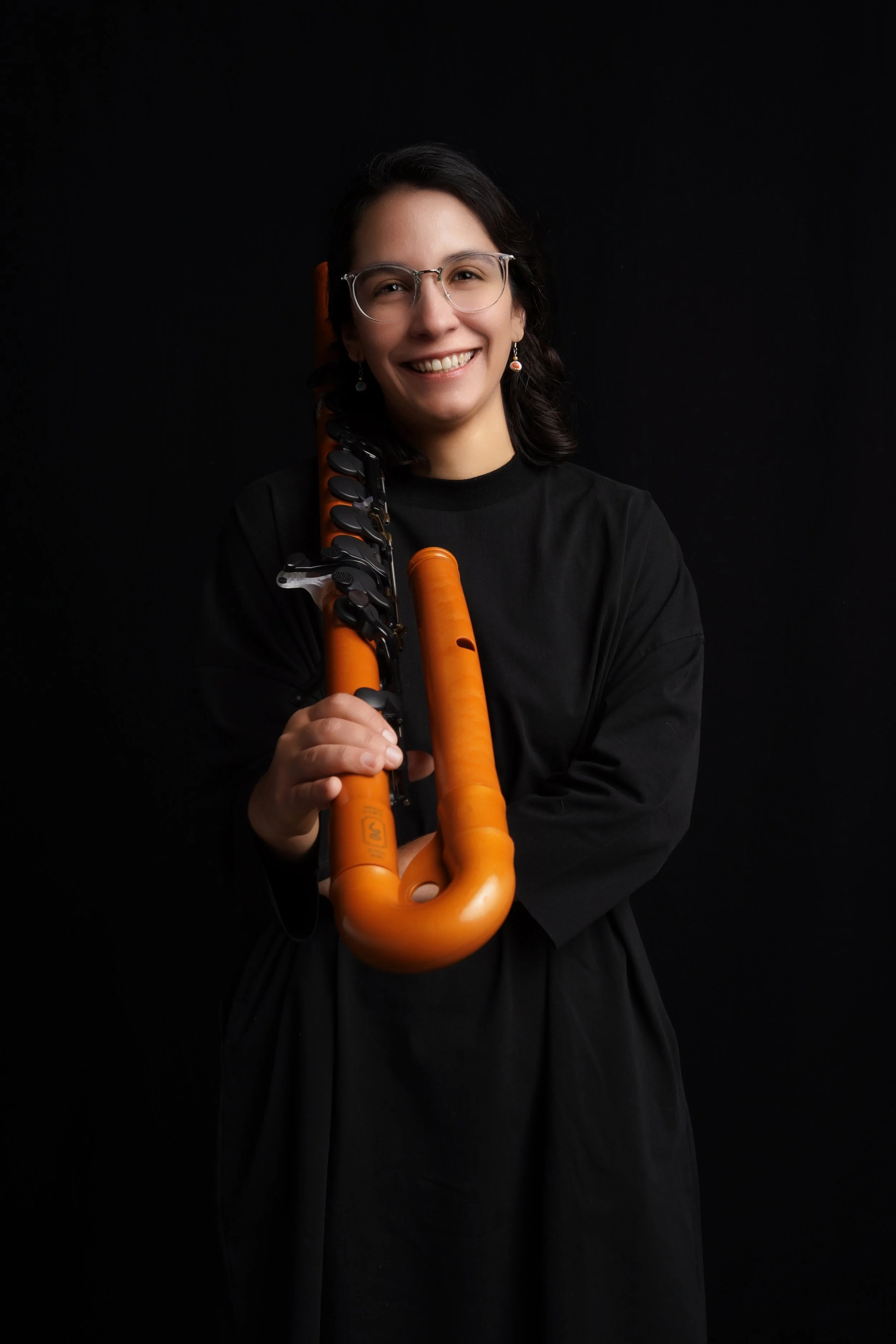
About the Author
Teresa Díaz de Cossio is a flutist, educator, and researcher whose practice bridges performance, scholarship, and community work across the U.S.–Mexico border. She holds a Doctorate in Contemporary Music Performance from UC San Diego, where her research focuses on composer Alida Vázquez, exploring archives, migration, and gender. As a member of in^set and co-producer of Neofonía, she develops collaborative artistic and pedagogical projects centered on community, creativity, and inclusion. She is a 2025-2026 Boulanger Initiative Research Fellow.